
Somehow, I never knew that Isamu Noguchi had had an affair with Frida Kahlo. I will always have a juvenile investment in the sexual virility of Asian men around the world, so to hear that Noguchi landed a woman as full-throttling as Frida Kahlo no less was, I counted, a win for the Asian male race. “It was very passionate,” Fran said of their romance, as he led me through an indoor market, around the side walls, and up a set of stairs where murals, painted by students of Diego Rivera, covered all three walls. We were at a rehab clinic—we passed someone sleeping on the landing, with a backpack as a pillow—which happened to be the site of Isamu Noguchi’s mural, commissioned by the Mexican government. More of a relief sculpture, the work—in red, gray, and pearl—presented a red fist in resistance against a swastika, cast like an omen in a comic book. The year was 1936.
I wouldn’t have known about this if Fran hadn’t taken me here. “This is a deep cut,” I said.
I had partly come to Mexico City with the intention of learning more about the Mexican Revolution, which was the first revolution in Latin America to successfully introduce socialist reforms. The constitution, ratified in 1917, radically expanded education, returned land to Indigenous people, and legalized unions. Earlier, Fran had taken me to the Secretary of Public Education to see Diego Rivera’s murals, commemorating the ideals of the nation. In one, Frida Kahlo dead-center is wearing a red shirt with a Communist star embroidered, holding a rifle.
“When he found out about the affair, he threatened to kill Noguchi, who fled back to Japan, “ Fran said.
Historically, Rivera has been more celebrated in Mexico than Kahlo. Only when seeing his murals in situ did I understand the surge of collective optimism and pride his murals evoke. But I wondered if now, Kahlo’s international fame had to do with her depiction of individuality, proposing the self as inherently more complex, in its infinite multiplicity, than the state, which will always try to control its mononarrative (wasn’t that the whole point of Rivera’s murals?). Just a few weeks before my trip, a 1940 painting of Kahlo’s sold at Sotheby’s for $54.7 million, the most expensive artwork by a woman ever auctioned.
“I used to hate her when I was young. She was everywhere,” Fran said, who was born and raised in Mexico City. Now, Kahlo’s painting Broken Column (1944), served as the inspiration for the show he curated of the same name, at the Museum of Mexico City, which I was in town to cover.
I, as well as the magazine I was writing for, had assumed the show was part of the regular programming at the historic museum, which once held exhibitions curated by the late Okui Enwezor, one of the greats. But in fact, the museum had been more or less defunct for the past twelve years, and was only recently resurrected and renovated by Fran and his friends, who had an idea one day to make an exhibition and knew how to make it happen.
He produced it entirely without state funding, which enabled him to include works that were critical of the Mexican government. It was a time when nearly all of the other museum exhibitions in the city were currently showing abstract and apolitical art from artists like Lilia Carillo, Marta Palau, and Elsa-Louise Manceaux.
For weeks, student protesters had been camping in tents outside the Zócalo, not far from the museum, ever since the Morena government failed to protect the left-wing mayor Carlos Alberto Manzo Rodríguez from assassination. People have been telling me reports of an anonymous cadre of men, masked and covered in black, showing up to protests, instigating violence between the police and the students, and then disappearing. For “Broken Column,” the artist Ramon Saturnino’s sculpture don’t speak; don’t talk (2025) was originally supposed to be displayed in the museum courtyard, in solidarity. It is composed of black abstract structures modeled after police barricades, instantly recognized by leftists from Occupy Gezi to Black Lives Matter. In Mexico City, every student protest is an echo of the 1968 Tlatelolco Massacre when the Mexican Army killed up to 400 people at a student protest. When the local authorities banned Saturnino’s sculpture from being exhibited in the public realm, it was relocated to the galleries, where the work took on a largely apolitical, minimalist idiom, like Dan Flavin’s orthogonal sculptures. As it was now displayed, don’t speak; don’t talk explored formal relations of the modernist grid to the viewing body, yet those relations felt largely irrelevant to the context from which it had been forcibly alienated.
A child of the Enlightenment, I—and a lot of us in the Global North—tend to see a dyad, often but not necessarily dialectical, between formalism and politics, as if the former existed in an ideal world of beauty for beauty’s sake, and the latter in the real world where beauty was merely a tool in the international struggle for power and self-determination. I had asked Fran, in the taxi, what he thought the role of beauty was in some of these works of institutional critique.
“It’s a tool,” he said, somewhat uncertainly.
So I went looking for beauty in the galleries, and found it in In the Air (2003–25) by Teresa Margolles, a Mexican artist who has a forthcoming solo exhibition at MoMA in New York. In the corner of her installation, a machine blew bubbles over the grand double staircase at the entrance of the former palace, over which hangs a large mural of historic Tenochtitlan, original to the building. The child-like whimsy of the bubbles starkly contrasted their source, made from water at morgues used to wash, for autopsy, the murdered bodies of Mexico, which silently funnel statistics on a daily basis.
In Mexico, an overwhelming majority of homicides go unprosecuted. Up to ten women a day are killed a day. Over four thousand are raped a day. What we now know as the femicides first began in Juárez in the 90s, when women were kidnapped from factories, and erupted after 2006 when President Calderón launched the war on drugs, sending the national army on the cartels. In 2019, Adriana Ruiz Muñiz, a sports model and alleged lover of the Tijuana druglord El Tío, was murdered by two men, who tore off her fingernails and cut off her pinky fingers and filmed her decapitated body on a cell phone video likely circulated on the dark net. Today, a majority of the femicides are crimes of domestic violence by lovers, ex-lovers, or family members. Mothers and feminists and artists and intellectuals have demonstrated in the streets, peacefully protesting with pink glitter bombs, and on social media, demanding justice for their daughters and sisters and cousins.
In Grieving, Cristina Rivera Garza writes,
Mourning, the psychological and social process through which the loss of another is publicly and privately recognized, is perhaps the most obvious instance of our vulnerability and, thus, our human condition. When we mourn the death of another, we accept from the outset, whether consciously or unconsciously, that the loss will change us, forever and in definitive ways.
To allow the work of grief to change oneself—redefining one’s relationship to the past, and therefore renegotiating the possibilities for how one will engage with the future—is a personal process that is already at once politicized, regarding the femicides. Rivera Garza goes on to accentuate how Antigone’s mourning is personal and familial, and it is in direct defiance of the state, embodied by King Creon. In Mexico, too, the mourning of the femicides is a personal grief in direct opposition to the incapability or unwillingness of the state to respond substantially to mass emergency. This way this dynamic, this tension, expresses itself in Margolles’s sculpture is beauty. Her bubbles, which in their childishness stand for innocence, elegize the dead. Its beauty is meant to be offensive, as innocence is offensive, because it reserves the exclusive right to condemn.
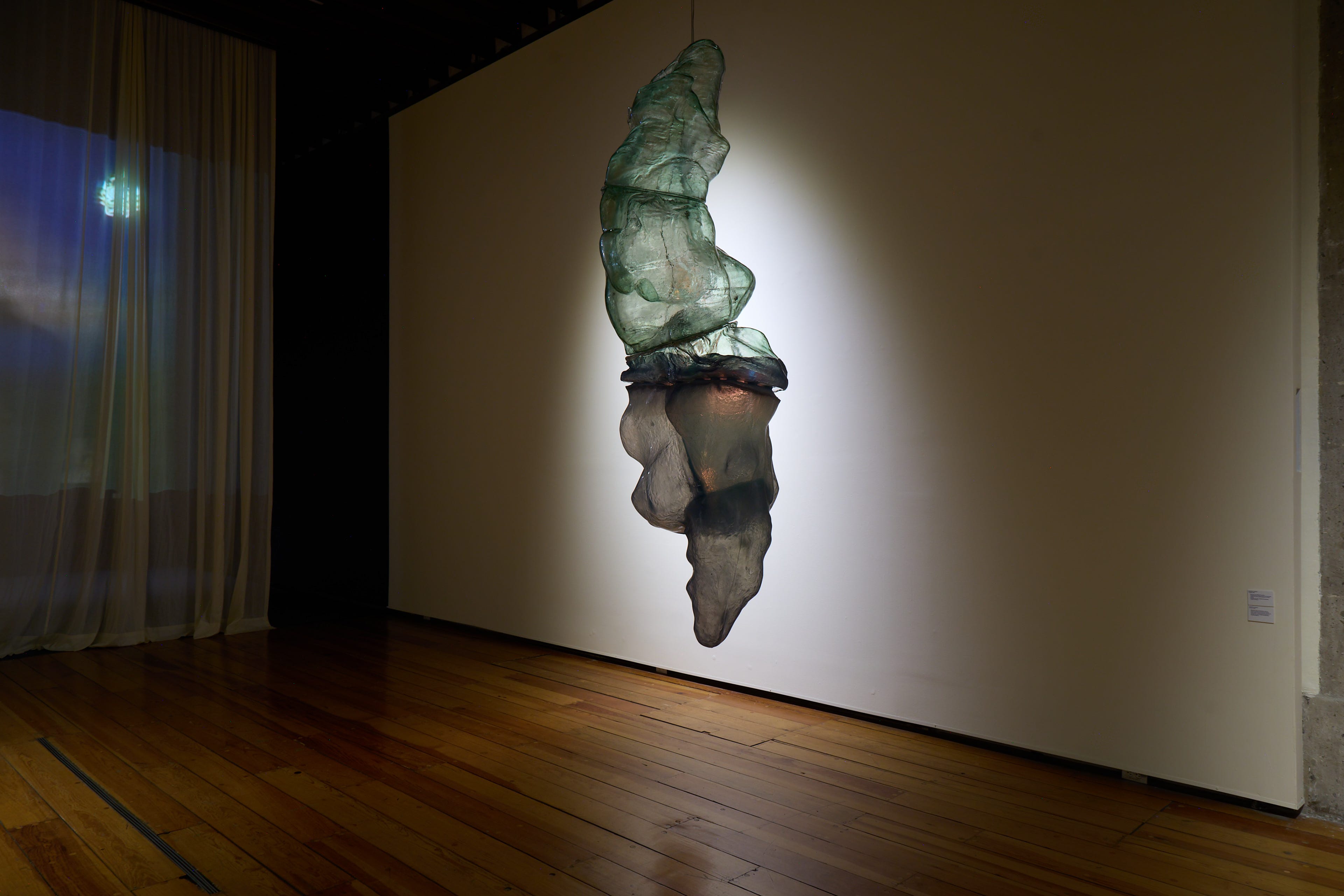
These mutilated bodies of murdered women, with their legs chopped off and hung over a freeway overpass, were echoed in Berenice Olmedo’s haunting sculptures, which appear like severed body parts, because they are combines of forms cast from medical prosthetics designed for amputees. When I visited her studio, I saw these prosthetics, piled up unceremoniously, and various stalactite-like 3D-printed forms she was working on. She told me the works were in response to Mexico’s death rate, which one can attribute to a variety of sources, like the Mexican health care system defunded by austerity, or the normalization of casual murder. Her work in the “Broken Column” show is called Pneuma (2025), cast from prosthetic limbs and synthetic organs. The hanging sculpture of gleaming, translucent orthotic plastic is grotesquely alluring. Does one call this beauty? Not all of Olmedo’s body sculptures are gendered, but this one is female. Attached to a motor, the sculpture—made from breast implant material—periodically inflates, mimicking human breath. The title “pneuma” is the Greek word for “breath.” I recalled the cell phone video of Adriana Ruiz Muniz’s mutilated body, downloaded by teenage hackers and snuff film collectors, trading it in secret as a winking souvenir of what humanity is capable of. It is unclear if Adriana was decapitated while she was still alive, but even after it has been mutilated, somewhere, if only in the part of the imagination that is grief itself, her body is still breathing. And what else is grief if not that imaginary memory, which has nothing to do with emotional catharsis. It’s a political reckoning.
*
On my second day, I visited the artist Iñaki Bonillas at his home. His wife was an art critic, before she had pivoted to journalism in recent years. They were leftist intellectuals; Iñaki said they felt ostracized because they were critical of the ostensibly left-wing party in power. But in Iñaki’s view, there was no left-wing party in Mexico anymore.
By the kitchen, there was a wall of CDs, a collection that included Latin American jazz (that wasn’t Bossa Nova), and classical recordings by composers I hadn’t heard of. I mentioned that my father trained as a classical pianist, before the Cultural Revolution forced him to drop out of the Conservatory, and so Iñaki played a recording of Jean-Philippe Rameau of the French Baroque—my first time hearing of him—performed by Marcelle Meyer, a French pianist in the early 20th century when female soloists were uncommon.
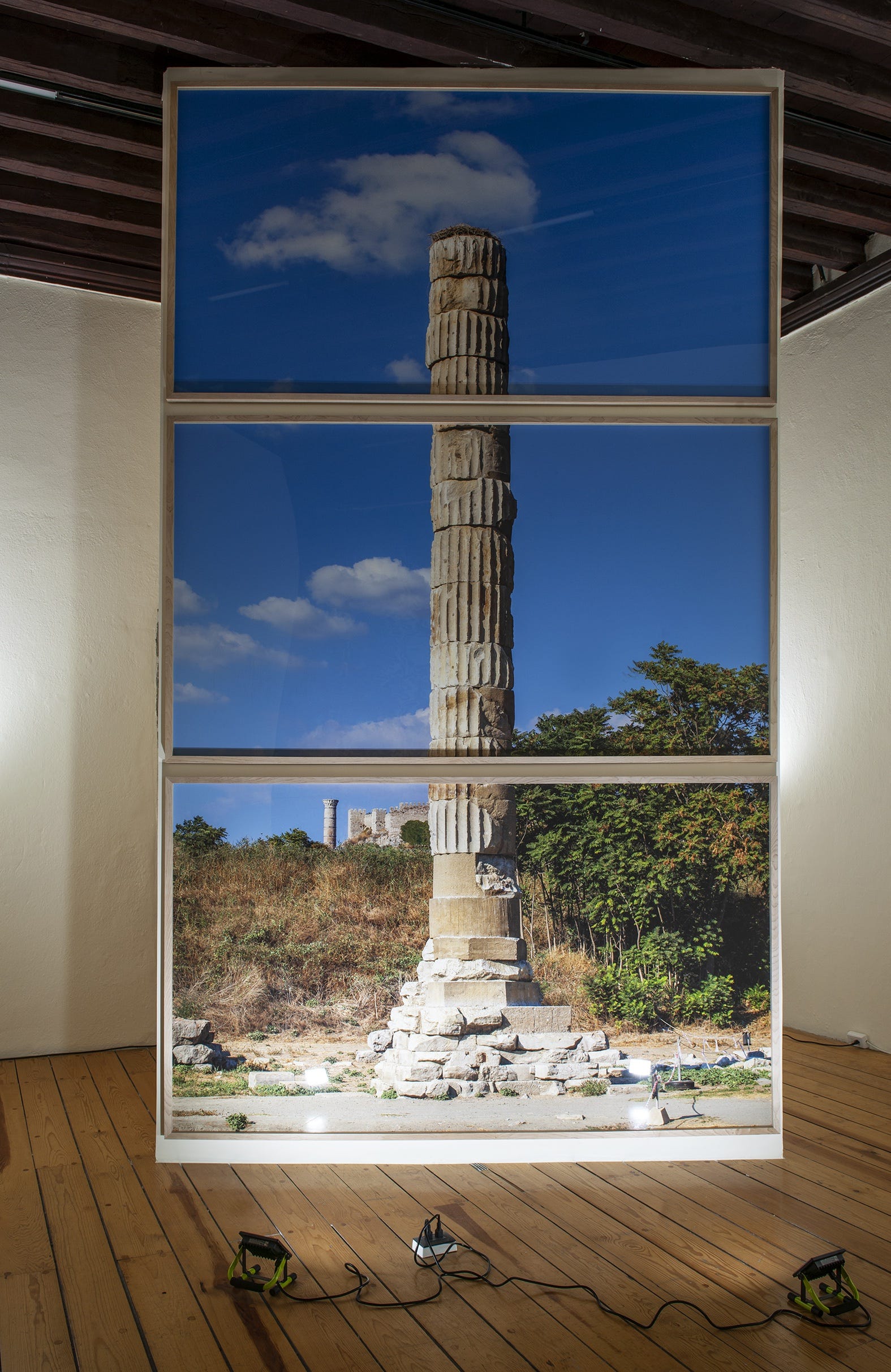
Iñaki had a life-size photo installation in “Broken Column,” Orphan Column (2025), of the ruins the Temple of Diana in Ephesus, Turkey. It was difficult not to see it as the ruins of a bygone democracy in a present-day country where Erdoğan has held his authoritarian reign since 2003. In Mexico, each president is limited to a single, six-year term, but after the Mexican Revolution, the PRI maintained one-party rule for 71 years, until the “Democratic Transition” after the free election of 2000. When López Obrador won the presidency in 2018 with the left-wing Morena party that he founded, he campaigned on promises of expanding welfare and increasing social spending without raising taxes. This was posed as a win for democracy, yet during his term, he consistently tried to roll back democratic reforms—forcing Morena officials to donate 10% of their income to party campaigns, paying off magazines and newspapers for favorable media coverage, defying bans against campaign advertisements, and publicly doxxing journalists critical of his relationship to the cartels—to ensure victory for his Morena successor Claudia Sheinbaum over the presidency and carry his legacy.
Nicolás Medina Mora writes in the NYRB, “One gets the sense that AMLO believes that free elections are desirable in theory but that a benevolent party needs to protect the popular will until the rotten elites he accuses of stealing his victory in 2006 are neutralized.”
Like many on the left, Iñaki was swayed by AMLO’s progressive campaign. He promised to roll back the national army, largely criticized as instigating a full blown civil war against the cartels, unleashing an era of Shakespearean violence. Once in office, AMLO did the opposite. He disbanded the civilian Federal Police (set up in 2009), and created a fully militarized National Guard, a new law enforcement agency that now oversees many civilian services, like running state-owned businesses, airports, and railways—casting a militarized shadow over public life.
“It’s one of the most corrupt times in the history of corruption in Mexico,” Iñaki said.
In 2019, the military erected Gabriel Orozco’s design for Chapultepec Park in a former military field, previously lauded as one of the great works of contemporary public sculpture. In Artforum, Benjamin Buchloh had written, “The final dialectics between contemporary sculpture as devalorized commodity and the utopian sculptural and architectural telos of remembering or revealing the possibility of conditions of simultaneous collective reception can find a viable model in the pragmatist conception of actually accessible utilitarian functions.”
But the next day, when I told Fran I wanted to see it, he said, “It’s shit.”
“One of the worst things Orozco ever did,” he said, as we passed it in a taxi. I saw vague structures, the color of a sand-dollar, behind trees. “It could have been good. But everything the military builds is shit.”
“I kind of want to see it.”
“It’s just this bridge, that’s it.”
The park’s construction had been part of an “urban renewal project,” stemming from AMLO’s belief that a surge in state-led development in infrastructure was the way to lift Mexico out of poverty. The idea was to ignite an industrial revolution to unite a divided nation. Railways, resorts, pipelines were built. The pinnacle of this effort was to build a $19 billion oil refinery, which was supposed to grant Mexico what AMLO called “energy sovereignty,” the ability to supply the country’s gas and electricity almost entirely by its own resources. Yet the economic justification for this is hazy at best (it was still cheaper to import oil from Texas, which might be why in 2021, his administration bought an oil refinery in Deer Park).
The effort was falling apart. In recent years, PEMEX, the state-owned oil company, has been beleaguered by groups like cartels stealing oil, and selling it as discounted “narco fuel” to gas stations, either by physically tapping the pipelines, or smuggling foreign oil, which faces high tariffs, into the country from Texas, by bribing military and customs officials. The military has technically been hired to protect against smuggling, but several have been arrested for collaborating or accepting bribes.
Orozco’s sculpture seemed to be little more than a psy-op for AMLO to curry favor with the public. After talking to Iñaki and Fran, it was hard to read between the lines to see what Buchloh meant by “pragmatist conception” and “actually accessible utilitarian functions.” The idea was that the public park reintroduced the use-value of sculpture (it was useful to people) over the exchange-value of art market commodities (because the park was free). Buchloh goes on to say that Orozco “orchestrates a triumphant synthesis of public space, sculpture, architecture, and collective conditions of simultaneous reception,” along with “the celebration of use value as a condition of collective defiance of spectacle.” Yet this was precisely the logic that the AMLO administration had failed to pick up on. If the newly militarized regime was justified by “use value” or “pragmatism,” rather than an inherent moral good, the pragmatism was failing. PEMEX was over $100 billion in debt, and the cartels were running fiefdoms. In context with the Morena government, Chapultepec Park couldn’t be anything but a spectacle: an aesthetic show of ideals designed to efface their total absence in a political reality where social conditions have remained unchanged since the corporatist PRI regime.
In the taxi, Fran took me to the Fondazione Prada instead, to see an exhibition of previously unreleased film footage—outtakes, B-reel—from Alejandro González Iñárritu’s Amores Perros (2000).
Wandering shadowy black box galleries, I watched outtakes and B-reels of Mexican streets, cerulean painted doors, cyberpunks with orange hair. A wise man lay down in his own pool of blood. Underground dogs fought, with their lanky, shirtless owners dogging them on. In its shameless devotion to aesthetics for their own sake—which happens when these films are taken out of the narrative context of the feature itself—the reels evacuated themselves of ambition and went straight to the hearts of the people. After all, this had been the age-old conflict between Soviet Constructivism and kitsch. Beauty always creeps in through the backdoor. Amores Perros had no ideals of progress, aesthetically or narratively, yet it gave Mexicans an aesthetic to imagine their own lives, or their national identity in, with something less aspirational than it was romantic. Like fashion for the mind. There isn’t a single character that emerges from Iñárritu’s iconic “hyperlink” trilogy—Amores Perros, 21 Grams, and Babel—but a kind of collective aura, a vibe.
I asked Fran if Iñárritu was to Mexico what Wong Kar Wai was to Hong Kong, where I had gone earlier in the year for Art Basel.
“I think that’s right,” Fran said.
From the light licking his cheekbones, he looked alive.
*
When I went back to the Círculo Mexicano that night, I thought of Iñaki Bonillas’ photograph of the broken column at the Temple of Diana. The only time I had seen it was in 2011, when I had been living in Turkey, first as a student in Ankara and then going on to work as a graphic designer in Istanbul. The Arab Spring had not quite reached Turkey, where Erdoğan was still seen as a contemporary FDR for his healthcare reform, including an expansion of medical services to rural areas. Yet there was talk of a Kurdish uprising. Kurds are one of the largest stateless peoples of the world. In the Southeast, also referred to as Kurdistan, separatists were sympathetic to the militant rhetoric of the Leninist leader, Abdullah Öcalan, exiled on an island in the Sea of Marmara. At the time, I wasn’t fully out as gay. Close people knew, others didn’t. Perhaps this is why my political awareness fixated on Kurdish people, who were “closeted” as it were, banned from speaking or teaching Kurdish in public, or performing traditional dances. They preserved their culture secretly, through oral histories, backchannels, and distributed Kurdish-language literature through hacker collectives. With friends, I traveled through the Southeast, and then to Iraqi Kurdistan, as far as Erbil. I spoke to several Kurds, some in English and some in halting Turkish, some as bus drivers and some as spontaneous dinner hosts, who were endeared, or amused, by this strange, Chinese American kid from the suburbs who was hell-bent on believing he had something in common with them, from Mardin to Urfa, and even to Diyarbakır, the capital of Kurdistan, which five years later would be razed to the ground. No one I spoke to had any idea it would take thirteen years for Assad to fall from power.
Perhaps with that trip in mind, I came to Mexico City intending to hang out with Mexican leftists and come back with something like solidarity, which I believed could and did happen between strangers. What I came back with was something like a shared mood. To live in a country where the collective has been sold out over a handful of corrupt individuals, is to distrust the very constitution of collectivity, made up of individuals you distrust as much as your own stupid self; this is paranoia.
When Fran had picked me up from the airport at ten in the morning, I asked, “How did the cartels get so involved in the government to begin with?”
“It’s because the CIA worked with them to sell drugs in the States,” Tony, a gallerist in Mexico City, said in the backseat. His face was so impossibly handsome that I kept staring at him during the whole trip, which made things awkward.
Trading CIA conspiracies is basically what gay guys in the international art world do instead of watching sports. Except this one was new to me.
“Does everybody in Mexico just assume that?”
“It’s obvious,” he said.
I felt stupid, not already knowing this as a basic fact of the country I was just now visiting. Many Mexicans still believe that the 1985 killing of DEA agent Enrique “Kiki” Camarena was because he uncovered a covert partnership between the CIA and the Guadalajara Cartel where drugs, smuggled and laundered in the States, and protection networks helped fund groups like the Nicaraguan Contras, weakening leftist movements across Latin America during the Cold war.
Here’s another conspiracy: Just a day before I flew to Mexico City, a shooter from a CIA-backed unit in Afghanistan, had shot two National Guard members in Washington D.C., prompting the Trump Administration to immediately foreclose all immigration to the U.S. from Afghanistan and halting all asylum requests, deepening his war on immigration. If you read between the lines, you see the CIA coercing a former asset from Afghanistan into a staged, high-profile shooting to legitimize the President to antagonize the country. To those in the know, it was a show of force that it had done something like this before and was ready to do it again.
I hadn’t slept in two days. Flying out the day after Thanksgiving, I had gone from a party where Mike Servito was playing, and straight to the airport, where I didn’t sleep. Now that I was back at the Círculo Mexicano, reading Judith Butler to put me to sleep, the thought struck: What if I just never fell asleep?
I panicked. I started hearing voices in my head. I had not renewed my Xanax prescription before leaving for Mexico, and my heart rate was accelerating.
“I need help,” I said in English to the woman sitting at the concierge in an open courtyard. It was eleven in the morning in Mexico, midnight in New York. I should have fallen asleep by now by natural causes.
“I’m so sorry,” she said as if my grandmother had died. This is not the affect I wanted.
“I need a doctor.”
I saw a ripple behind her eyebrows. She walked out from behind the desk and guided me to a padded bench below an island of birds of paradise fronds. “Drink some water,” she said, putting a blanket over me.
“What’s going on?” a man in a wide-brimmed hat and an island shirt asked. There are a thousand muscles in the human forehead, and as I raised my head to meet his eyes, I felt all thousand of those muscles, wiggling.
I tried not to shame myself for freaking out, which would just add to my freak out. In these moments of psychic surplus, I become a split mind. I began telling Geoff that it was good that he asked for help, it took him a lot of inner work to get to a place where he was comfortable making a big deal out of his own pain, which he often suppressed because he didn’t think he deserved space. Nobody thinks you’re entitled. You did a good thing and I’m proud of you.
“It’s hard for Americans, just coming to Mexico all alone. Are you alone? Is there anyone I can call?”
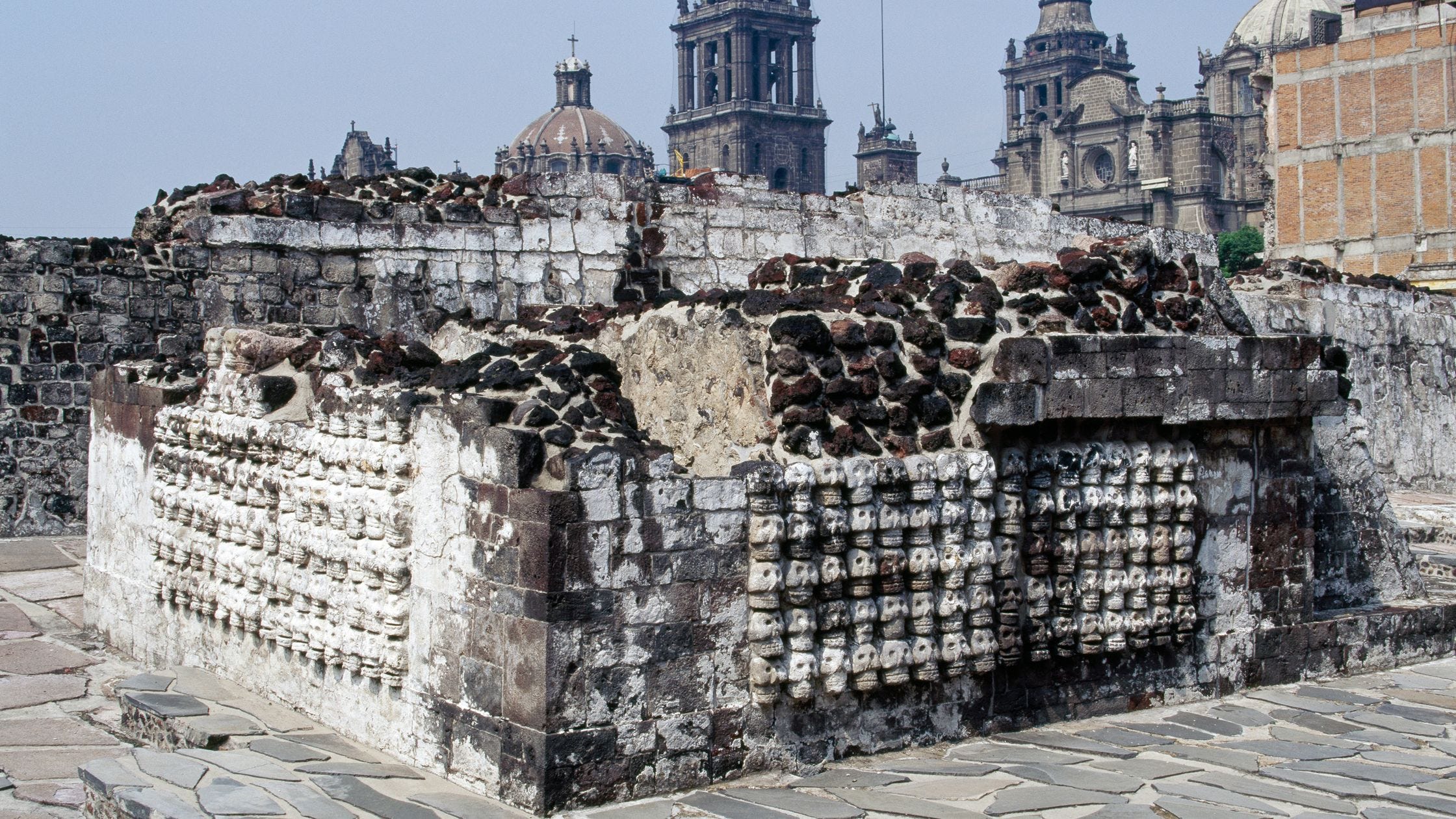
But I wasn’t just some dumb American who got lost in Mexico City. I had a masters in journalism, and I was here to write for a very prestigious magazine. What I didn’t tell them was that I was hearing voices in my head. I had brought my medication for this sort of thing, but it wasn’t working. The voices spoke like spirits or demons, cackling, celebrating. I didn’t know where I was, whose territory I belonged to. In the Book of Daniel, there are ancient “princes” and “principalities,” not actual politicians, but unseen spiritual entities that controlled certain territories like Greece and Persia and Israel. We were so close to the Templo Mayor that from the rooftop of the Círculo Mexicano, you could see the sacred temple of Tenochtitlan during the Aztec empire, where they held human sacrifices. Tlaloc, the god of agriculture, needed the tears of children for rain. Children, raised explicitly for this purpose, were fed well, bathed and purified. The day of the ritual, they were adorned with turquoise jewelry and shells as their hearts were cut out of their bodies and sacrificed, their bodies buried in mass graves with frogs and jade and obsidian.
“What do you need?” the man in the hat asked, deadpan and kind.
“I need a Xanax.”
His posture stiffened. “That is not a service that the hotel can provide you.”
That’s not what I meant. But of course I was being shamed for trying to ask for drugs on the secret menu. The demons were shaming me for the secret agencies of my country who had asked for and exploited the drugs on the secret menu. On the spot, I promised myself I would never buy coke again.
“I understand that,” I said, shaking. “I need the doctor.”
The police came instead. After a long phone call, a cop in a blue uniform and a white hat said that the doctor would not be able to come for four hours. Then someone got on the phone with a private doctor, who said he could come right now for $2000, or in the morning for $45. I had flown into Mexico on someone else’s dime, but I said I was willing to pay for the $2000. I handed over my passport to the desk, which is what I do when I have paranoid breakdowns; I just foist my government ID onto strangers who never asked for it.
By now I understood that the doctors were not coming, but Geoff did not. His face kept doing the forehead thing, until the hotel staff offered to give him Room 208 for the night, the top suite at the hotel, which wasn’t booked. When he went up to the suite, there was a floor-fountain where water trickled relaxing sounds over pebbles, and you could turn it on or off with a light switch. He was hoping for a warm bath, but there was only a shower. He was offered a Caesar Salad, on the house, and he actually ate the first Caesar Salad of his life in the year 2025. The calories seemed to calm his nerves. Outside the French balcony doors, beats and pads were playing from some party that was loud and invisible. I tried to tell him that noise complaints were not a thing in Mexico City. He was going to have to deal. You just have to deal.
A small bag of chocolate covered almonds were left on the crisp white pillow. An hour later, I slept a dreamless sleep. By morning the voices were gone.
When I checked out of the hotel at the end of the stay, there were various hotel employees who asked me if I was okay. They spoke in Spanish, and then rubbed their stomach, and I already knew what they were talking about. I was embarrassed that I had made such a fuss, which is exactly what a dumb American would do.
I ordered and Uber, and stood by the entrance of the courtyard with my carry-on. It was November and hot. Then a cop approached me, tapped his hand on my shoulder. It seemed like he was fucking with me, to see if he could scare me. I did not have time to figure out if he was military or a cop or the National Guard—there seemed to be uniformed men with guns on their belts patrolling every goddamn corner in this city, and I needed to get out. I physically jolted back, gulping the lump in my throat, momentarily cutting off my oxygen.
“I’m your friend,” the cop kept trying to say.
I looked at him startled.
“He was there the night that you were sick,” a store clerk nearby was translating. “He wants to know if you’re okay.”
The cop looked me in the eyes and his face was kind. “I’m your friend.”
One of the strongest aspects of this is how honestly it portrays paranoia. Your writing never fully romanticizes or dismisses it. Instead, it explores the frightening space where legitimate political distrust and psychological fragmentation begin bleeding into each other. That tension makes the essay deeply unsettling because the reader is never allowed the comfort of completely separating delusion from reality. In a world already saturated with corruption, surveillance, violence, propaganda, and institutional betrayal, the piece asks a terrifying question: at what point does paranoia stop being irrational and become an exaggerated response to truths that already exist beneath the surface? What a great read!